
The Vibrant World of Protea
About
Representation
Location
University of Melbourne
Focus
Protea Flower and Non-Human Agent
Year
2024
Keywords
Protea Flower, Vector 2D, Sketch
Overview
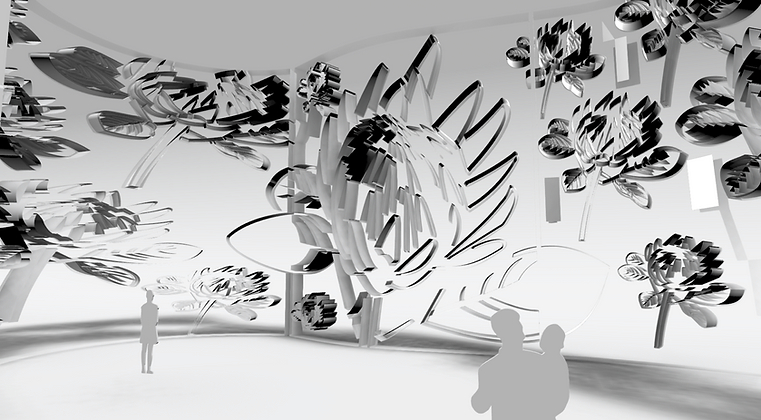
This project explores the intersection of observation, representation, and design through multiple media. I began by documenting a botanical object and its component parts, using photography and hand-drawing, then create a vector representation in Affinity Designer. Finally, I designed two art installations in Rhino, each depicting the object from the perspective of a different agent: the honeybee and the sugarbird.
The aim of this task is to develop the ability to observe, analyse, and reinterpret natural forms through multiple representational techniques. This is related to architecture, as it trains me to think beyond the human scale, and strengthens core architectural skills: observation, drawing, digital representation, and spatial translation.

In-class Activity
Photography


DO YOU KNOW?
The sugarbird and honeybee both have mutualistic relationships with the protea. The sugarbird feeds almost exclusively on protea nectar and, in return, pollinates the plant as it moves between flowers. Its beak and feeding behavior are well-suited to the flower’s structure.
The honeybee also aids in pollination by collecting nectar and pollen, guided by the protea’s scent and UV patterns.
scent and UV patterns.
Hand-drawn


The Trap of
Humancentric Design
I initially fell into the trap of humancentric design during my sketching phase, viewing the curvy bridge merely as an aesthetically pleasing walkway for Unimelb staff & students rather than considering the needs of the butterflies.
Later, I adjusted my design to better accommodate butterflies and improve its constructability. For example, the curvy bottom of the bridge makes it much more expensive and difficult to build without providing any benefit for the butterflies. Therefore, I omitted it from my final design.
.png)
Brainstorm Sketch

Vector 2D


3D Modelling
This project invites you to imagine what it would be like if a sugarbird or honeybee were human-sized, and we could see the world through their eyes. The two art installations are designed in Rhino to represent a protea flower—as experienced by these creatures. This shift in viewpoint helps us understand the role of scale—a key concept in architecture.


CONCLUDING WORDS
I honed my skills with new tools like Affinity Publisher, Affinity Designer, and Rhino 7. These programs have expanded my technical abilities, allowing me to bring more precision and creativity to my designs. Comparing my initial work to the final outcomes, I can see clear evidence of my growth, both in skill and understanding.
For me, as an aspiring architect, this journey has been transformative. Moving forward, I’m committed to exploring multi-species design and integrating these learnings into a specialization that prioritizes the needs of diverse communities and ecosystems.