
Rewilding Wings
About
Ecological Design
Location
Professor Walk, University of Melbourne
Focus
Golden-Rayed Blue Butterfly
Year
2024
Keywords
Urban Rewilding, Thought Experiment
Overview
This project, completed for the Representation: Foundation of Design (FoDR) subject during my freshman year at the University of Melbourne, explores Urban Rewilding and Thought Experiment concepts. Inspired by Stephen Mushin's book Ultrawild, this project aims to propose 'insane' yet theoretically possible ideas.
Focusing on Professor's Walk, the design seeks to support existing and new non-human species while envisioning a ‘rewilded’ site. The goal is to move beyond humancentric design and advocate for solutions that genuinely prioritize non-human species.
_edited.jpg)
Site Analysis at Professor Walk

Current Food Web

Speculative Food Web
DO YOU KNOW?
The Golden-Rayed Blue Butterfly (Candalides Noelkeri) is currently categorized as ‘Endangered’ by Zoos Victoria due to habitat degradation from cropping and grazing. Found exclusively in Wimmera (3 hours drive from Melbourne CBD), it is the only butterfly known to be endemic to Victoria. These two reasons explain why I chose this species to be the targeted agent of my design.
The Trap of
Humancentric Design
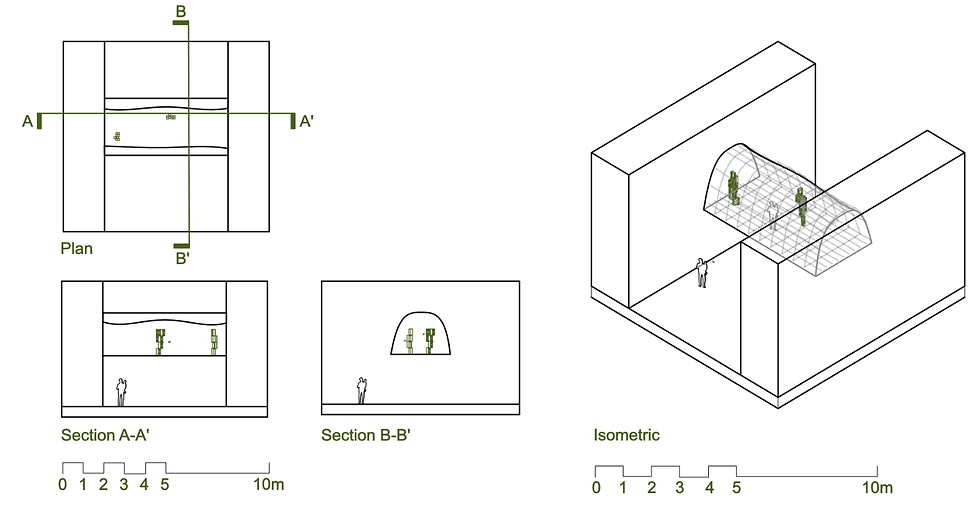
I initially fell into the trap of humancentric design during my sketching phase, viewing the curvy bridge merely as an aesthetically pleasing walkway rather than considering the needs of the butterflies.
Later, I adjusted my design to better accommodate butterflies and improve its constructability. For example, the curvy bottom of the bridge makes it much more expensive and difficult to build without providing any benefit for the butterflies. Therefore, I omitted it from my final design.
.png)
Brainstorm Sketch




Away from 3D Modeling
Imagining a “rewilded” future, I produced a series of 5 perspective sketches that depict a sequence of interconnected events from the viewpoint of the Golden-Rayed Blue Butterfly living on my site (See Below and Above).
The issue I am seeing with many of the projects is that relying heavily on 3D rendering often results in overly polished outcomes that may not effectively convey the design story from a non-human perspective.
In contrast, exploratory mark-making with different media can open surprising new possibilities.
For example, using bleed pen produces unpredictable textures and patterns that bring life to my outlines. Pastel’s rough, uneven application on textured paper can evoke a sense of movement or atmosphere that would be hard to simulate in digital 3D.
By pushing beyond the boundaries of my 3D models, I not only gain the freedom to tell the butterfly’s story more vividly but also expand my skill set for future projects.
_edited.jpg)
Idea Development
CONCLUDING WORDS
This project has reshaped how I view my future in architecture. Critiquing humancentric design has taught me the importance of creating spaces that integrate and support both human and non-human life. As I advance in my studies, I aim to incorporate ecological principles into my work, designing structures that respect and sustain diverse ecosystems rather than merely accommodating human needs.