
ESD Project
About
Environmentally Sustainable Design
Location
South Lawn
Focus
Sun Analysis, IEQ, Passive Design, Water Management
Year
2025
Keywords
Passive Design, Ventilation, HVAC
Overview
This project envisions a light-filled, sustainable pavilion where 16 students can gather, study, and connect with nature. Tucked into South Lawn’s landscape, the 10.8 x 4.8x 2.7 m structure features a small kitchenette, a sheltered outdoor area, and a thoughtfully designed garden.
Blending passive design strategies with carefully chosen materials, the space embraces natural light, ventilation, and energy efficiency. Every element—from window placement to the outdoor deck and planting—works together to create a calm, flexible, and inspiring environment.

Using Andrew Marsh’s solar analysis tools, I explored orientation and shading strategies tailored to Melbourne’s climate
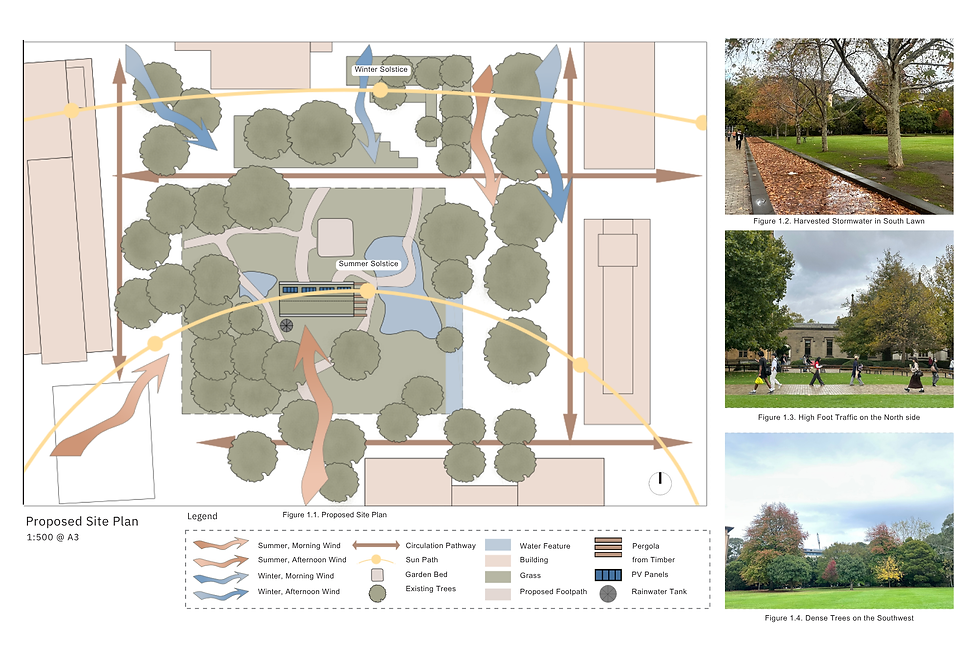
Site Plan

Physical Model and Solar Studies

Diagrams of Passive Design Strategies
These diagrams may seem simple at first glance, but behind them lies a process of research and critical thinking. I studied resources from yourhome.gov.au and explored various Youtube videos to deeply understand the concepts.
Through this, I’ve learned that every design decision—no matter how small—requires thoughtful investigation to ensure it aligns with both the design intent and the climate context. Clarity in representation comes only after clarity in understanding.

Floor Plan - Passive Design Stragies
FUN FACT
Smart passive design—like proper orientation, shading, and ventilation—can reduce a building’s energy use by up to 40%, cutting tons of CO₂ emissions each year. That’s like planting dozens of trees just by designing smarter!

Material Selection

Indoor Environment Quality
The Trap of
Humancentric Design
I initially fell into the trap of humancentric design during my sketching phase, viewing the curvy bridge merely as an aesthetically pleasing walkway for Unimelb staff & students rather than considering the needs of the butterflies.
Later, I adjusted my design to better accommodate butterflies and improve its constructability. For example, the curvy bottom of the bridge makes it much more expensive and difficult to build without providing any benefit for the butterflies. Therefore, I omitted it from my final design.
.png)
Brainstorm Sketch


Energy Systems

Estimating energy demand in Excel
to determine the appropriate size and capacity of solar panels

Water and Landscape Design
UP NEXT: TECTONICS!

Load Path and Bracing Diagrams
As I explored structural detailing, I learned about the purpose of diagonal and shear bracing—how they work to stabilise a structure against lateral forces like wind. Understanding their function not only deepened my technical knowledge but also reminded me that every element in architecture carries both purpose and meaning.

Structural Details


Figure 2.4. Tutorial activity: Mapping out bearer and joist layout to determine span, floor load width, and roof load width

Behind Resolved Drawings
Working through the structural detail helped me appreciate the beauty of construction—how every design decision required research and careful calculation. For example, determining the type and size of a bearer required understanding the load path, span, floor load width, and roof load width, then referencing structural tables to find the most suitable cross-section.
This learning was supported by in-class activities and drop-in sessions where I could ask questions and clarify doubts. At the time, my phone was packed with quick reference sketches from these sessions—each one capturing a step in my growing understanding.
Figure 2.5. Rough sketch by tutor illustrating key structural concepts during class.

Figure 2.6. Tutorial activity: Referencing Wesbeam’s LVL tables to determine the optimal bearer size based on span and load calculations.

Section - where all components connect
CONCLUDING WORDS
Even when a building appears simple from the outside, I’ve learned that behind it lies a world of thought, research, and careful consideration. Through this project, I gained a deeper understanding of Melbourne’s climate, passive design strategies, energy efficiency, water treatment, and technical detailing. I now see that every element carries meaning, and every design decision requires intent, context, and responsibility.